The following sectors are defined as high climate impact sectors according to NACE:
(A) Agriculture, hunting, forestry and fishing
(B) Extraction of raw materials
(C) Manufacturing
(D) Supply of electricity, gas and district heating
(E) Water supply, sewerage, waste management and remediation of soil and groundwater
(F) Construction
(G) Wholesale and retail trade, repair of motor vehicles and motorcycles
(H) Transport and freight handling
(L) Real estate.
You can get help finding your undertaking’s NACE code(s) using the Danish Business Authority’s tool for industry codes. The first four digits of your undertaking’s code constitute the NACE code. The last two digits of the industry code are a Danish subdivision that you do not need to specify in the ESG template.
The number of convictions due to violation of anti-corruption and anti bribery laws.
B10 - Training
Training hours refer to the development of skills and competencies (both formal, such as courses, and informal, such as on-the-job training).
Landsfordeling
The total number of employees your undertaking has in countries outside of the country your undertaking operates in. This includes both permanent employees and employees in various forms of temporary employment. The country is the country where the employment contract was concluded.
It is irrelevant where the employee resides. An employee may, for example, have a Danish employment contract but reside in a country other than Denmark
Number of men
Number of men in the organisation
Number of women
Number of women in the organisation
Other
Number of other in the organisation
Employee satisfaction (Not a EU-requirement)
Percentage of employees who are satisfied with working at X – from the employee survey.
Absence due to illness (Not a EU-requirement)
Number of full days that all own employees are absent due to illness and therefore not at work, relative to the total number of FTEs. Parental leave must not be included.
Why included: If the company has a disproportionately high number of sick days per FTE, it may indicate lower employee satisfaction and/or safety issues. In addition to being costly, it can also lead to challenges in attracting talent.
Number of temporary employees
Full-time equivalent (FTE) is a unit that indicates the workload of an employee in a way that makes workloads comparable in different contexts. An FTE of 1.0 corresponds to a full-time position.
Number of permanent employees
Full-time equivalent (FTE) is a unit that indicates the workload of an employee in a way that makes workloads comparable in different contexts. An FTE of 1.0 corresponds to a full-time position.
Total number of employees
Full-time equivalent (FTE) is a unit that indicates the workload of an employee in a way that makes workloads comparable in different contexts. An FTE of 1.0 corresponds to a full-time position.
C5 - Number of self-employed workers
Self employed
In this context, self-employed people covers:
Temporary workers provided to your undertaking by a temporary employment agency or other type of undertaking primarily engaged in employment activities
C5 - Number of temporary agency workers
Temporary worker
In this context, temporary worker covers:
Temporary workers provided to your undertaking by a temporary employment agency or other type of undertaking primarily engaged in employment activities
You can refer to NACE code 78 to define undertakings that are engaged in employment placement/temporary employment agency activities.
Employee turnover (If over 50 FTE)
Employee turnover refers to employees who leave your company either voluntarily or due to dismissal, retirement, or as a result of death caused by a work-related accident.
Information
Annual mass flow of described material. The selected material is assessed as being a significant or critical material for the company.
Information
A nature-oriented area is an area primarily used for nature conservation or nature restoration. Nature-oriented areas may be located on a facility's site and include roofs, facades, drainage systems, and other elements designed, adapted, or managed to promote biodiversity. Nature-oriented areas may also be located outside the organization’s facility area, provided the area is owned or managed by the organization and primarily used to promote biodiversity.
Information
A sealed area is any area where the original soil has been covered (such as roads) to make it impermeable. This impermeability can impact the environment.
Information
Total land use of the biodiversity-sensitive area.
Information
A biodiversity-sensitive area is defined at the EU level or international level. It may, for example, be areas that belong to the Natura 2000 network, UNESCO World Heritage, or Key Biodiversity Areas.
Information
Only applies for the pollution of air, water, and soil that is discharged from your own company
Information
Renewable fuel sources include, for example, biofuels such as biomass, biodiesel, and bioethanol.
Information
Non-renewable fuel sources include, for example, coal, oil, and gas
Information
Fuels in this context include anything that is burned, such as gas, natural gas, biomass, etc.
Information
Renewable energy sources include, for example, solar, wind, hydropower, etc.
Information
Non-renewable energy sources include, for example, fossil fuels used to generate electricity.
Information
Scope 1 refers to the direct emissions from activities that the company itself controls. These are emissions from the company’s own vehicles and facilities for heating and energy production, such as natural gas plants.
Information
Scope 1 refers to the direct emissions from activities that the company itself controls. These are emissions from the company’s own vehicles and facilities for heating and energy production, such as natural gas plants.
Information
Scope 2 refers to the indirect emissions from purchased energy, including electricity and district heating. The emissions occur elsewhere, for example, at your local combined heat and power plant or district heating facility.
B3 - Energy Consumption (Electricity)
Electricity in this context explicitly includes energy consumption for heating, steam, and cooling.
Information
Net revenue
public/report.revenue_modal_content
Information
Scope 3 refers to the indirect emissions from the company’s value chain. This includes all of the company’s upstream and downstream activities. Therefore, Scope 3 focuses on all the indirect emissions that are not covered by Scope 2.
Information
Scope 3 refers to the indirect emissions from the company’s value chain. This includes all of the company’s upstream and downstream activities. Therefore, Scope 3 focuses on all the indirect emissions that are not covered by Scope 2.
Information
Scope 3 refers to the indirect emissions from the company’s value chain. This includes all of the company’s upstream and downstream activities. Therefore, Scope 3 focuses on all the indirect emissions that are not covered by Scope 2.
Information
Scope 3 refers to the indirect emissions from the company’s value chain. This includes all of the company’s upstream and downstream activities. Therefore, Scope 3 focuses on all the indirect emissions that are not covered by Scope 2.
Information
Scope 3 refers to the indirect emissions from the company’s value chain. This includes all of the company’s upstream and downstream activities. Therefore, Scope 3 focuses on all the indirect emissions that are not covered by Scope 2.
Information
Information
The Greenhouse Gas (GHG) Protocol is an internationally recognised standard for measuring the CO₂eq emissions of undertakings, recommended by the European Commission. The calculation model in the Climate Compass is based on this standard.
public/report.step3f8
public/report.step3f8_modal_content
public/report.step3f9
public/report.step3f9_modal_content
Gender diversity in the management
Management level
Management level is considered the level below the board of directors – unless your undertaking wishes to use a different definition. In that case, the definition should be described together with the disclosure.
public/report.step_s2f4
Governance Body
In this context, the governance body refers to the highest decision-making authority in your undertaking, e.g. the Bord of Directors
public/report.step3f11
Antal kvinder i ledelsen
public/report.step3f12
Antal andre i ledelsen
Number of work-related accidents
Work accident. A work accident is a sudden event related to work that causes physical or mental harm to a person.
Rate
Rate defines the number of work-related accidents pr. 100 full-time employees pr. year
Number of work-related fatalities
Number of work-related fatalities
- Due to work injury/accident
Number of work-related fatalities due to work injury/accident
- Due to work-related ill health
Health issues resulting from smoking, substance and alcohol abuse, physical inactivity, unhealthy eating habits, and psychosocial factors that are not work-related are not considered work-related.
Wage gap between men and women (If over 150 FTE)
Percentage wage difference between men and women
Percentage of employees covered by collective bargaining agreements
The percentage of employees covered by collective agreements. The Collective agreement always covers all employees within the relevant sector, regardless of whether the individual employee is a member of a trade union or not.
public/report.step3f20
public/report.step3f20_modal_content
public/report.step3f21
public/report.step3f21_modal_content
public/report.step3f22
public/report.step3f22_modal_content
Water Withdrawal (Total for all locations)
Water withdrawal is the sum of all water drawn into the company’s area from all sources for any use during the reporting period.
Water Withdrawal (From sites located in high water-stress areas)
Water stress/water scarcity is defined as areas/regions where the percentage of total water withdrawal is high (40-80%) or extremely high (more than 80%).
Water Consumption (Total for all locations)
Water consumption is the amount of water drawn into the company's (or facility's) area, which is not released back into the water environment or to a third party during the reporting period.
public/report.step7f4
public/report.step7f4_modal_content
Total Waste Volume
If your company only has household waste that is collected in the usual manner, you can report 0 for this item.
Waste Management - Percentage of total waste sent for recycling/reuse
If your undertaking only has household waste that is collected in the usual manner, you can report 0 for this item.
Recycling/Reuse: When disclosing information on the total annual waste diverted to recycling or reuse, the undertaking should consider the waste that is sorted and sent to recycling or reuse operators (e.g. the amount of waste put into recycling container or sorting of waste into certain categories of materials and their delivery to waste treatment facilities) rather than the waste that gets effectively recycled or reused.
Waste Management - Percentage of total waste that is hazardous waste
If your company only has household waste that is collected in the usual manner, you can report 0 for this item. Examples of hazardous waste in this context include, for example, used batteries, oils, pesticides, mercury-containing equipment, and fluorescent lamps.
Green-Way Transport Ltd - ESG Report 2024 - ESG365
Green-Way Transport ESG Report
Green-Way Transport Ltd., headquartered in Burgas, Bulgaria, is a dynamic logistics provider serving Europe and Central Asia. Since our founding in 2017, we have focused on delivering reliable and efficient transport solutions tailored to the needs of our clients.
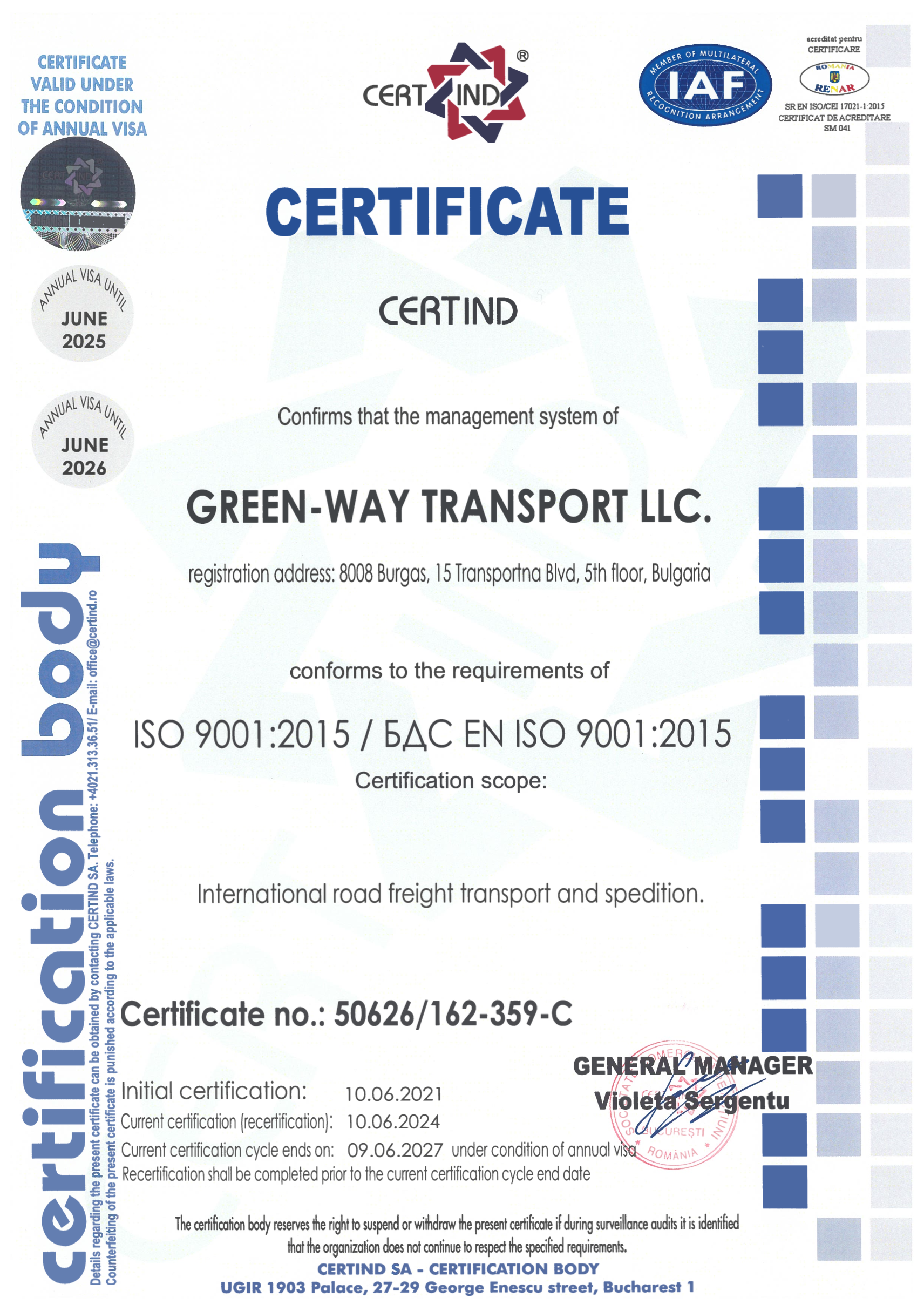
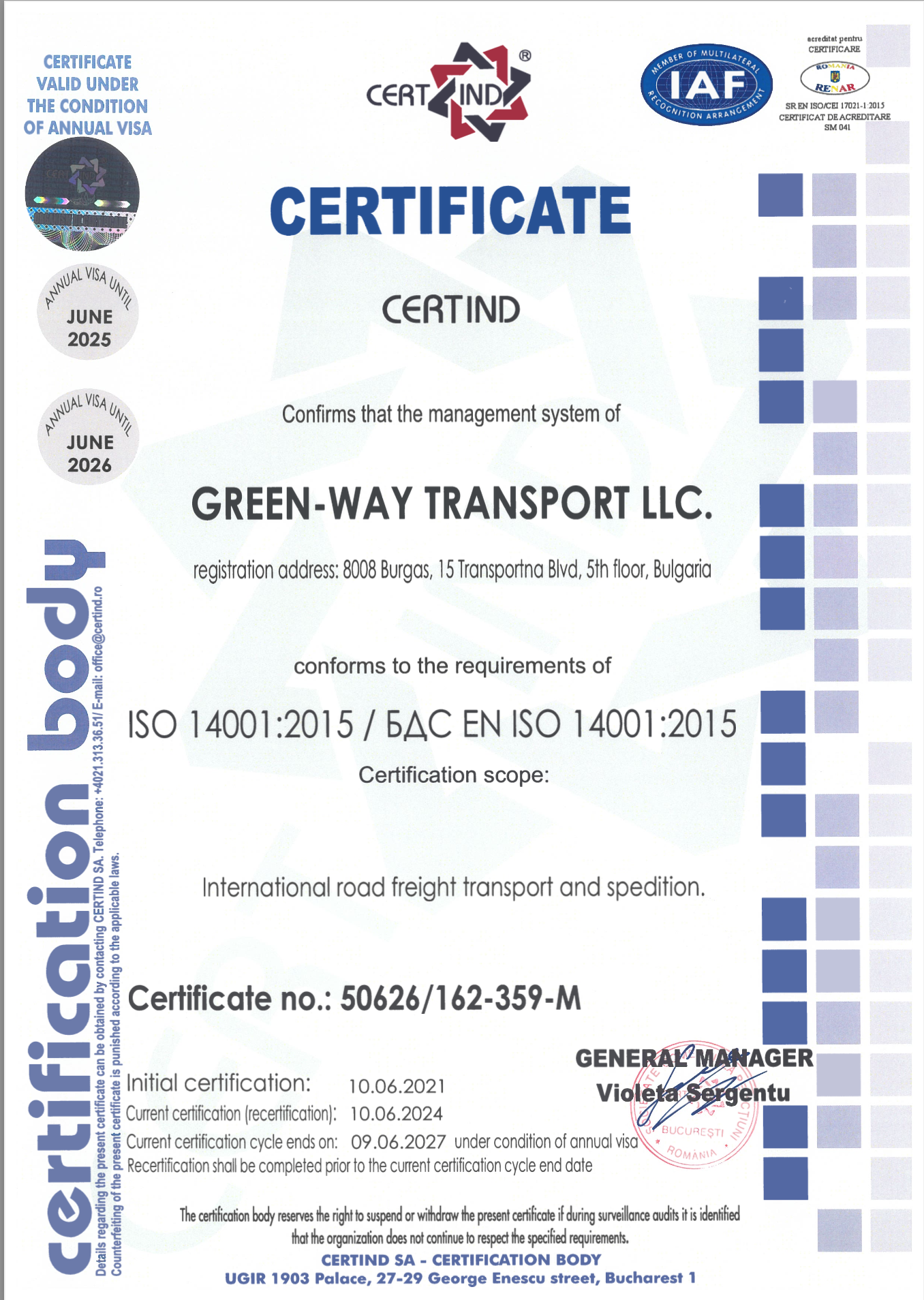
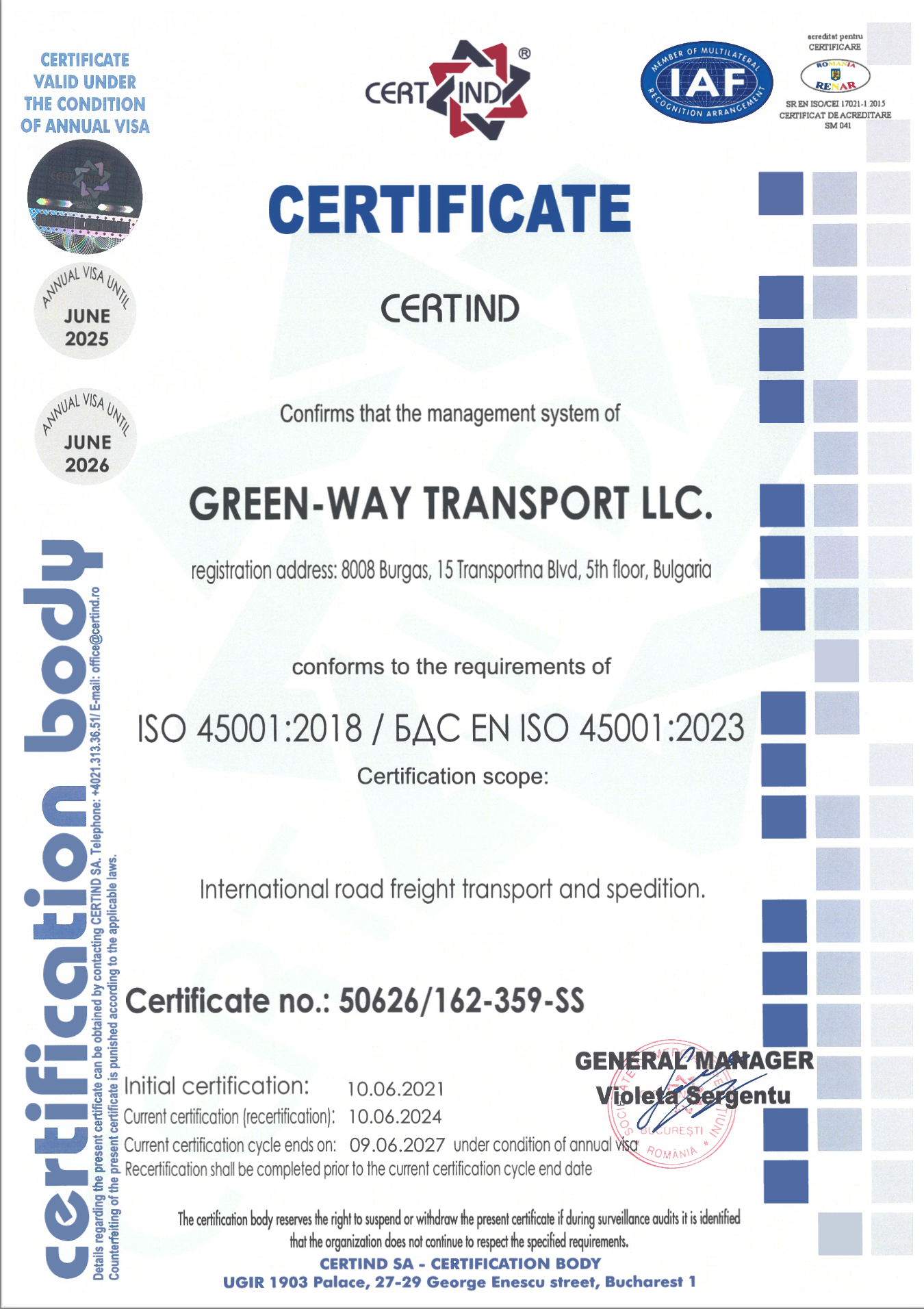
This ESG report presents our commitment to responsible business practices across environmental, social, and governance dimensions. With internationally recognized certifications—ISO 9001:2015 for quality management, ISO 14001 for environmental management, and ISO 45001 for occupational health and safety—we uphold rigorous standards in every aspect of our operations.
Through in...
novation, transparency, and a strong focus on continuous improvement, Green-Way Transport aims to contribute positively to the industry and the communities we serve.
Emissions from own facilities for heat and energy production
tCO2e
-
Emissions from own vehicles
tCO2e
26,41
Emissions from utility companies (including electricity and district heating)
tCO2e
1,39
Total CO2eq emissions from Scopes 1 and 2
tCO2e
27,80
B3 - GHG Emissions - Scope 3
Energy and Processes (Emissions - distribution and transmission losses as well as emissions associated with fuel extraction e.g., coal)
tCO2e
0,84
Procurement (Consumption of goods, materials, products, and services)
tCO2e
1,20
Transport (Employee transport, goods transport to company, goods transport from company to customer, air travel, etc.)
tCO2e
2.338,79
CO2eq total (Scope 1+2+3)
tCO2e
2.368,63
GHG - Intensity (CO2e Total/Turnover)
tCO2e
0
B3 - Energy Consumption (Electricity)
Renewable energy consumption
MWh
1,97
Non-renewable energy consumption
MWh
0,36
Total energy consumption
MWh
2,33
B3 - Energy Consumption (Fuels incl. District heating)
Renewable energy consumption
MWh
25,04
Non-renewable energy consumption
MWh
106,26
Total energy consumption
MWh
131,30
Total energy consumption
MWh
133,63
B6 - Water
Information
Unit
2024
Water Withdrawal (Total for all locations)
m3
513,40
Water Withdrawal (From sites located in high water-stress areas)
m3
0
B7 - Resource use, circular economy and waste management
Total Waste Volume
tons
0,25
Waste Management - Percentage of total waste sent for recycling/reuse
%
0
Waste Management - Percentage of total waste that is hazardous waste
%
0
B8 - Employees
Number of temporary employees
FTE
0
Number of permanent employees
FTE
55
Total number of employees
FTE
55
B8 - Gender diversity in the organization
Number of men
FTE
48
Number of women
FTE
7
Other
FTE
0
B9 - Health and safety
Number of work-related accidents
Work accidents
0
Rate
0
Number of work-related fatalities
Deaths
0
- Due to work injury/accident
Quantity
0
- Due to work-related ill health
Quantity
0
B10 - Remuneration and collective bargaining
Wage gap between men and women (If over 150 FTE)
%
20
Percentage of employees covered by collective bargaining agreements
%
0
All employees receive a wage that is at least at the level of the national minimum wage
B10 - Training
Average number of hours of training
For men
Hours
2,18
For women
Hours
2,18
For other
Hours
0
B11 - Convictions and fines for corruption and bribery
Number of convictions
Convictions
0
Total fine amount
Euro
0
SDG Goals
Sustainable Development Goals
Controlled eTruck Operations with On-Site Renewable Energy
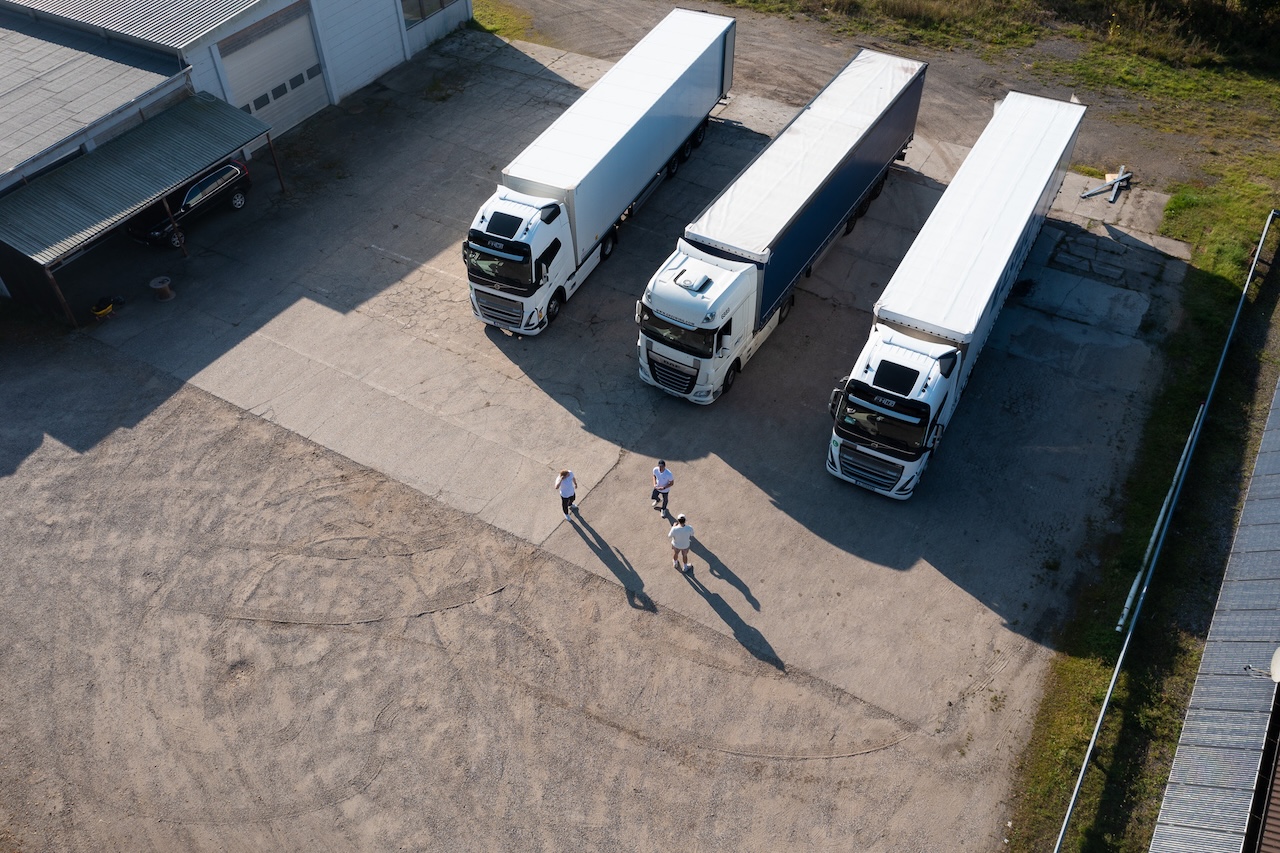
Green-Way Transport has implemented a CO₂-neutral transport setup by operating eTrucks on dedicated lanes powered by electricity generated from photovoltaic systems installed on warehouse rooftops. The company maintains 100% control over electricity production, charging cycles, and transportation times, ensuring traceability and efficiency
Inspired by 7. Affordable and clean energy
Health and Safety Integration in Driver Operations
The company uses 2- and 3-driver setups to reduce transportation lead times and driver fatigue, which directly supports safer working conditions. This approach reflects a commitment to risk reduction and employee well-being, core principles of ISO 45001
Inspired by 3. Good health and well-being
Quality and Efficiency through Intermodal Transport and Fixed Lead Times
Green-Way’s intermodal transport solutions and fixed-rate, fixed-lead-time services across Europe and Central Asia demonstrate a structured approach to quality and customer satisfaction. These services are designed to ensure supply chain visibility, scalability, and reliability, aligning with ISO 9001:2015’s focus on consistent service delivery and continual improvement
Inspired by 9. Industry, innovation and infrastructure
Environment (E)
Green-Way Transport takes a structured and transparent approach to managing its environmental impact. In line with the principles of ISO 14001, the company has implemented an environmental management system that emphasizes compliance, risk assessment, and continuous improvement.
Key initiatives include:
Fleet Optimization: The company operates vehicles powered by LNG (Liquefied Natural Gas) and HVO (Hydrotreated Vegetable Oil), which offer lower emissions compared to conventional diesel. These fuels are used where infrastructure and supply chains allow, and their performance is regularly reviewed.
Energy Monitoring: Green-Way uses ph...
otovoltaic systems installed on warehouse rooftops to generate electricity for its eTruck operations. Energy consumption and output are tracked to ensure efficiency and accountability.
Intermodal Transport: Where feasible, the company integrates rail and road transport to reduce road mileage and associated emissions. These decisions are based on route-specific data and client requirements.
Rather than claiming to be fully sustainable, Green-Way focuses on practical, data-driven steps to reduce its environmental footprint. The company publishes its progress and challenges transparently, recognizing that environmental responsibility is an ongoing process.
Social (S)
Green-Way Transport fosters a workplace culture rooted in safety, inclusion, and professional development. The company adheres to the principles of ISO 45001, ensuring a proactive approach to occupational health and safety. Employees benefit from structured training programs, clear communication channels, and a supportive environment that prioritizes well-being and growth.
Social responsibility extends beyond the workplace. Green-Way engages with local communities and partners to promote ethical practices and contribute positively to the regions in which it operates. The company’s transparent and respectful approach to stakeholder engageme...
nt reflects its values of fairness and accountability.
Governance (G)
Governance at Green-Way Transport is guided by the principles of ISO 9001:2015, emphasizing quality management, customer satisfaction, and continuous improvement. The company maintains clear operational procedures, risk management protocols, and performance metrics to ensure accountability and transparency across all levels.
Strategic decisions are informed by data-driven insights and a commitment to regulatory compliance. Green-Way’s governance framework supports ethical conduct, responsible leadership, and long-term value creation for clients, partners, and society.
Certifications, labels, etc.
ISO 9001:2015
ISO 9001:2015 sets out the criteria for a quality management system focused on meeting customer expectations and delivering consistent, high-quality services. It emphasizes risk-based thinking, process efficiency, and continuous improvement, helping organizations enhance performance and customer satisfaction.
ISO 14001 provides a framework for organizations to manage their environmental responsibilities systematically. It supports compliance with regulations, reduces environmental impact, and promotes sustainable resource use through planning, monitoring, and continual improvement of environmental performance.
ISO 45001 is the international standard for occupational health and safety. It helps organizations create safer workplaces by identifying and controlling risks, reducing incidents, and improving employee well-being. The standard promotes a proactive approach to health and safety through leadership, worker participation, and continuous improvement.